Repeated drug administration sometimes leads to a lack of sufficient response from the body.
This reduction in drug response occurs due to any of the three mechanisms, such as
- Tachyphylaxis
- Toleranace
- Desensitization
Though all of them lead to less responsiveness to the drug over time, their mechanisms vary.
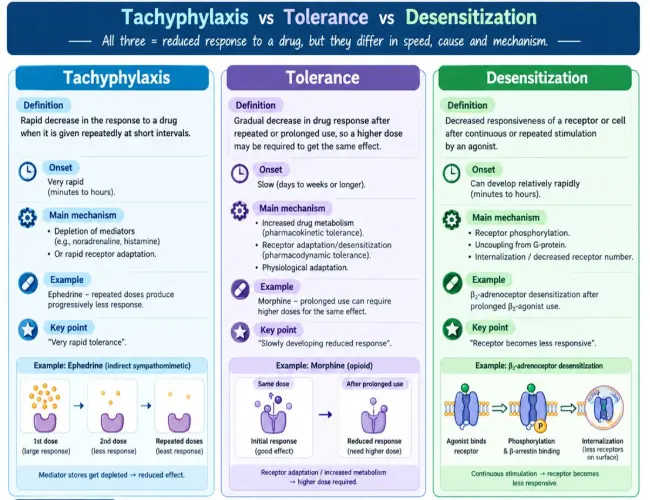
Quick Comparison of the three
| Charecteristic | Tachyphylaxis | Tolerance | Desensitization |
|---|---|---|---|
| Pharmacological response | Rapid decrease in drug response after repeated doses | Gradual decrease in response after repeated/prolonged use | Reduced response of a receptor to continued drug stimulation |
| Onset | Very rapid (minutes to hours) | Slow (days to weeks or longer) | Can develop within minutes to hours |
| Main Cause | Depletion of mediators or rapid receptor adaptation | Pharmacokinetic or pharmacodynamic adaptations | Receptor phosphorylation, uncoupling, internalization, or downregulation |
| Dose Needed | An Increasing dose may be needed quickly | An Increasing dose may be needed over time | Increasing drug concentration may produce less response |
| Reversibility | Rapidly reversible after a drug-free interval | Reversible, but may take longer | Reversible when stimulation is removed |
| Example | Indirect sympathomimetics (e.g., Ephedrine) | Morphine, benzodiazepines | β2-adrenoceptor desensitization |
Understanding them helps us overcome the problem for effective treatment in the clinic.
Tachyphylaxis
Tachyphylaxis is a rapidly developing decrease in drug response to a drug when it is administered repeatedly at short intervals.
- It is sometimes called acute tolerance.
- The most important feature of tachyphylaxis is “rapid onset of reduced response”.
- It may develop within minutes to hours, depending on the drug and mechanism.
- The common mechanisms include:
- Depletion of mediators: Some drugs produce their effects by releasing stored endogenous substances.
Example:
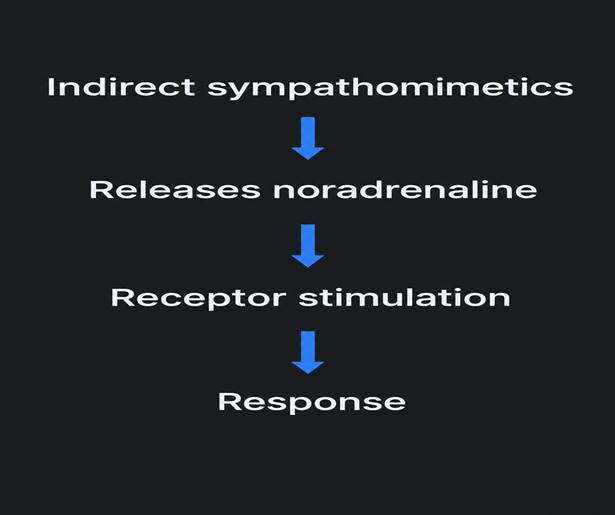
- Due to repeated administration, noradrenaline release is repeated, and stores become depleted, leading to reduced noradrenaline availability and a weaker response.
- Therefore, the next dose produces a smaller effect.
- Rapid receptor adaptation: repeated stimulation can cause receptors to become temporarily less responsive.
- Physiological counterregulation: The body may rapidly activate mechanisms that oppose the drug’s effect.
Important points:
- It develops quickly.
- Specifically occurs after repeated doses at short intervals.
- Response progressively decreases.
- Often due to the depletion of the mediator substance.
- Mostly reversible after temporary drug withdrawal (drug-free interval).
Dose response curve in Tachyphylaxis
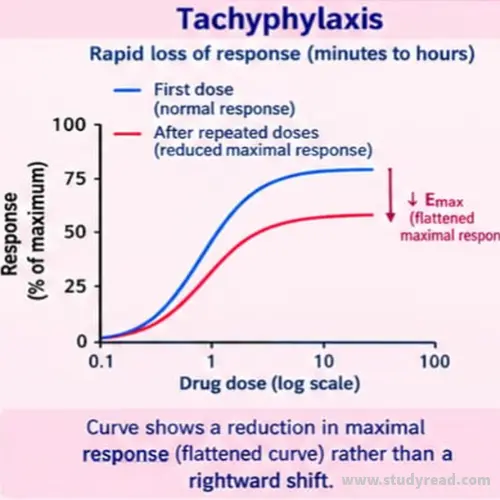
Example: Repeated doses of ephedrine at short intervals can produce progressively smaller cardiovascular responses because of depletion of available noradrenaline stores.
Tolerance
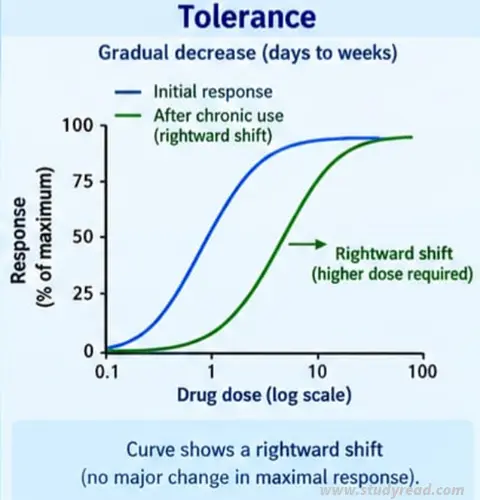
Tolerance is a condition in which repeated or prolonged administration of a drug produces a progressively smaller effect, so a higher dose may be required to produce the original response.
- Unlike tachyphylaxis, tolerance generally develops more slowly.
- The main characteristic of tolerance is “slow development of reduced drug response”.
- It may develop over days, weeks, or longer, depending on the drug.
Types of tolerance:
Pharmacokinetic tolerance:
- Here, tolerance arises from pharmacokinetic parameters of the body and is not linked to the receptor or the drug.
- The body metabolizes the drug faster than normal, leading to a lower concentration at the site of action.
Example:
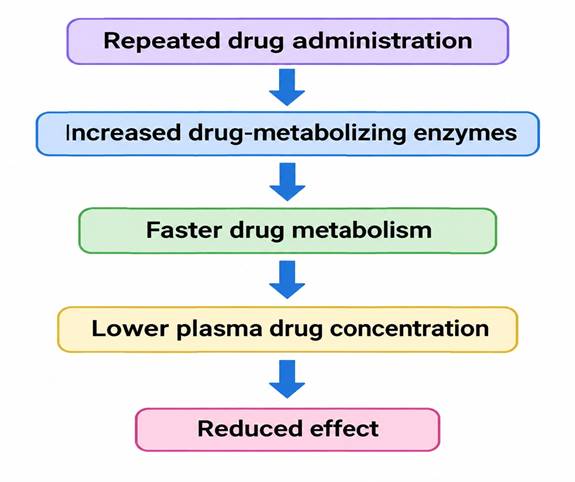
- This is also called metabolic tolerance.
Pharmacodynamic tolerance:
The drug concentration may remain adequate, but the target tissue becomes less responsive.
Example:
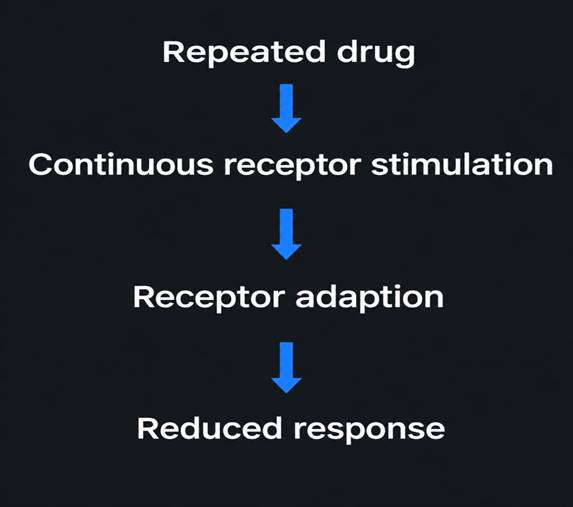
Example: prolonged usage of opioids such as morphine can lead to tolerance to several effects, and that means larger doses may be required to produce the same pharmacological effect.
Dose response curve in Tolerance
Desensitization
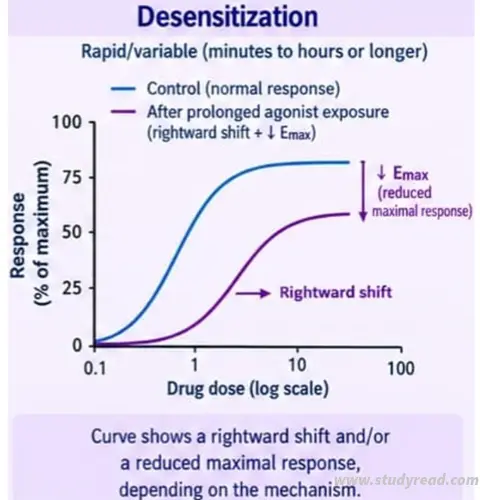
Desensitization is a decrease in the responsiveness of a receptor or signaling system following continuous or repeated agonist stimulation.
- It is primarily a cellular- and receptor-level phenomenon.
- The main characteristic of desensitization is “the receptor becomes less responsive to continued stimulation”.
Mechanism of desensitization:
Consider an agonist stimulating a receptor:
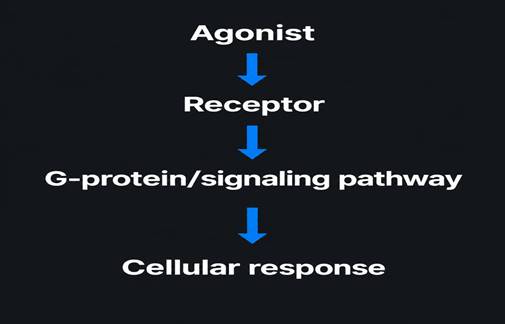
- With continuous stimulation, a continuous agonist that causes receptor phosphorylation and that reduces receptor signaling, leading to reduced cellular response.
- In some situations, the receptor may be internalized, reducing receptors on the cell surface and leading to a reduced response.
Types of desensitization:
- Homologous desensitization: Only the stimulated receptor becomes less responsive.
Example: A beta agonist stimulates the beta receptor, and the beta receptor becomes desensitized.
- Heterologous desensitization: Activation of one signaling pathway can reduce the responsiveness of multiple receptors or receptor systems, including receptors that were not directly stimulated.
Dose response curve in Desensitization
References:
- Tachyphylaxis
- Tolerance and Withdrawal
- Desensitization– The International Union of Basic and Clinical Pharmacology IUPHAR
- Opioids and the Physiology of Tolerance
