Receptors are the sensing elements that convey a signal received from the ligand (drug) into the cell.
There are 4 major types of receptors, like
- Type 1 (Ionotropic) Ligand-gated ion channel receptors: Fast (milliseconds)
- Type 2 (GPCR) G-protein coupled receptors: Medium (seconds to minutes)
- Type 3 (Kinase-Linked): Slow (minutes to hours)
- Type 4 (Nuclear Receptors): Very Slow (hours to days)
| Parameter | Ligand-Gated Ion Channels | G-Protein-coupled receptors | Kinase-linked receptors | Nuclear / Intracellular Receptors |
|---|---|---|---|---|
| Location | Cell membrane | Cell membrane (7-TM domain) | Cell membrane | Cytoplasm / Nucleus |
| Effector Mechanism | Direct ion channel opening | G-protein coupling (Gs, Gi, Gq) → 2nd messengers | Direct enzyme phosphorylation | Gene transcription & protein synthesis |
| Time Course (Response) | Milliseconds (ms) | Seconds to minutes | Minutes to hours | Hours to days |
| Key Examples | Nicotinic ACh, GABAA, NMDA | Muscarinic ACh, α/β Adrenergic | Insulin, Growth Factors, Cytokines | Steroid hormones, Thyroid hormones, PPAR |
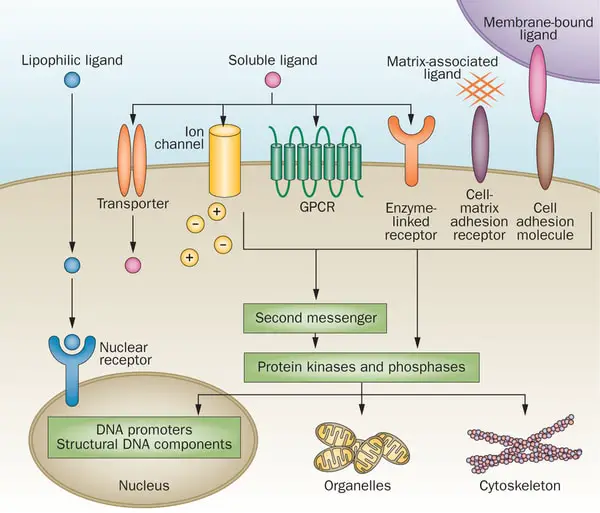
👉 A ligand is one that can bind to the receptor and produce a specific response. The ligands could be either drugs or endogenous molecules, such as neurotransmitters, opioid peptides, and hormones.
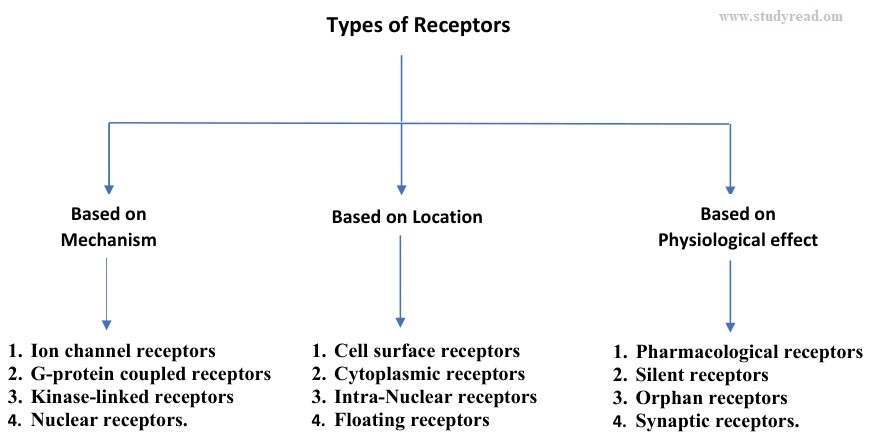
These receptors are located on cells and tissues and help regulate almost all of the body’s organs.
As per IUPHAR, there are hundreds of receptors in the body. They vary in the changes they induce in the body upon ligand binding.
Types of Receptors in detail
Based on their molecular structure and mechanism:
- Ligand-gated ion channel receptors
Ligand-gated ion channel receptors
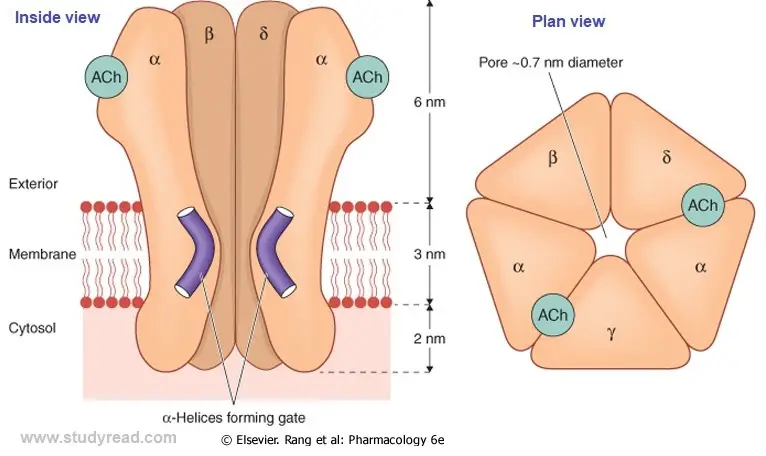
- They are also called ionotropic receptors.
- They possess a channel through which ions can move into and out of the cells.
- They are located on the cell membrane and have a ligand-binding site towards the external surface.
- The ligands could be biomolecules such as acetylcholine or GABA, or corresponding drugs.
- The nicotinic acetylcholine receptor is one of the prominent receptors in this category.
- It is made of 4 different subunits named α, β, γ, and δ.
- 👉 These receptors elicit the fastest response in microseconds/ milliseconds.
- Ions like Sodium, chloride, calcium, and potassium move into or out of the cell through them.
- These receptors coordinate bodily responses such as reflexes, the sense of pain, touch, and movement.
Examples: Nicotinic acetylcholine receptors and GABAA receptors in the nervous system.
G-protein coupled receptors
- This is the largest class of receptors. They are also called metabotropic receptors.
- These receptors are also membrane-bound but have their effector system in the cytoplasm.
These receptors are of 3 types as
- Rhodopsin family
- Secretin/glucagon family
- Calcium sensor family
These receptors act through both ligand-gated channels and also enzyme-linked pathways.
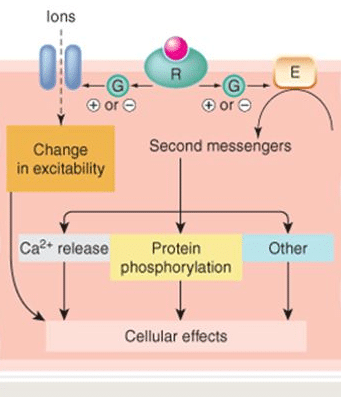
👉 The response through these receptors takes a few seconds.
Adenylyl cyclase (cAMP) Pathway
- Here, when the drug or ligand binds to the receptors, the enzyme adenylyl cyclase is activated on the inner side of the plasma membrane.
- ATP is metabolized to cAMP (cyclic AMP), which phosphorylates protein kinase (an enzyme).
- This phosphorylated protein kinase activates many reactions by phosphorylating proteins and enzymes.
Example: Glucagon activates the enzyme glycogen phosphorylase, which converts glycogen to glucose in the liver and skeletal muscles.
- Similarly, Muscarinic M2 receptors also work through this mechanism.
Other receptors with this mechanism include
- Adrenergic β-receptors,
- Follicle-stimulating hormone,
- Adrenocorticotropic hormone,
- Somatostatin,
- Thyroid-stimulating hormone, etc.
Phospholipase C / IP3-DAG pathway:
- The Phospholipase C/IP3-DAG (Inositol triphosphate-diacylglycerol) pathway is a vital signal transduction pathway initiated by G-protein coupled receptors (GPCRs).
- This pathway is essential for numerous cellular functions, including cell growth, differentiation, and hormone action.
Here’s a breakdown of the process:
- Activation of the G-Protein Coupled Receptor (GPCR)
The process starts when an extracellular ligand, such as a hormone, neurotransmitter, or growth factor, binds to a GPCR on the cell membrane.
This interaction activates the associated G protein, specifically Gq.
- Gq Protein Activation
Once activated, the Gq protein undergoes a conformational change, leading to the exchange of GDP (Guanosine diphosphate) for GTP (guanosine triphosphate) on its alpha subunit.
The activated alpha subunit of Gq then separates from the beta and gamma subunits. It interacts with Phospholipase C (PLC), an enzyme on the inner surface of the cell membrane.
- Phospholipase C (PLC) Activation
Activated PLC targets phosphatidylinositol 4,5-bisphosphate (PIP2), a phospholipid in the inner leaflet of the cell membrane.
PLC hydrolyzes PIP2 into two significant second messengers: inositol 1,4,5-triphosphate (IP3) and diacylglycerol (DAG).
- Role of IP3
IP3 is soluble and diffuses into the cytoplasm, binding to IP3 receptors on the endoplasmic reticulum (ER) membrane.
This binding triggers the release of calcium ions (Ca²⁺) from the ER into the cytosol, elevating intracellular calcium levels.
- Calcium as a Second Messenger
The increase in intracellular calcium ions activates various calcium-dependent processes, including muscle contraction and neurotransmitter or hormone secretion, and activates other signaling proteins such as calmodulin and protein kinase C (PKC).
- Role of DAG
DAG, the other product of PIP2 hydrolysis, remains in the plasma membrane due to its lipophilic properties.
DAG activates protein kinase C (PKC), which subsequently phosphorylates various target proteins, leading to alterations in cellular activities, including gene expression.
Kinase-linked or enzymatic receptors.
- These receptors are also cytoplasmic but have an extracellular part that binds to a drug or ligand.
- Their action involves enzymatic activation by phosphorylation.
- Then, gene transcription → protein synthesis → produces the effect.
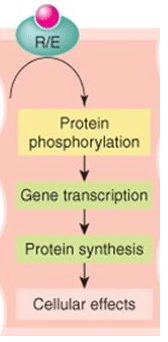
👉The response time of response is a few hours.
There are four different types of kinase-linked receptors, like
- Cytokine receptors.
- Receptor tyrosine kinases
- Serine/threonine kinases
- Guanylyl cyclase-linked receptors
Nuclear receptors
- As the name indicates, these receptors are located in the nucleus of cells.
- They get activated when ligand molecules enter the nuclear membrane and bind to them.
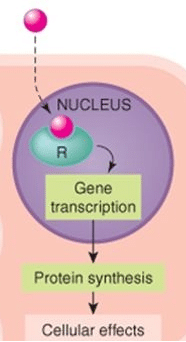
- 👉 Their response time is from hours to a few days.
These nuclear receptors are of two main types, like
- Class I: Ex: Estrogen and other steroid receptors.
- Class II: Ex: peroxisome proliferator-activated receptor
Other classification of receptors.
👉 Based on their location in the body
As per their location and distribution in the body, they can be classified as
- Cell surface receptors (Ion-channel and G-protein coupled receptors)
- Cytoplasmic receptors (Enzyme-linked receptors like JAK-STAT)
- Intra-nuclear receptors (The hormonal receptors located in the nucleus)
- Floating receptors
👉 Based on the physiological effect on the body
- Pharmacological receptors (These receptors elicit a response to drugs)
- Silent receptors
- Orphan receptors
- Synaptic receptors.
👉 Silent receptors
- Silent receptors are those receptors to which ligands bind with high affinity, but interestingly, no pharmacological effect is produced.
Ex: Plasma proteins. Many drug molecules bind to them but have no effect.
👉 Orphan receptors
- These are receptors that lack well-defined endogenous ligands.
- But they can produce a response when other ligands bind to them.
- In other words, their endogenous ligands have not yet been discovered.
- Once the endogenous ligand is identified, it will be given a specific name.
👉 Synaptic receptors
These receptors show their effects at synapses after being stimulated by neurotransmitters.

Thank you, this is an excellent simplified review.
excellent concise review.