Muscarinic receptors are a part of the parasympathetic system.
They are stimulated by the neurotransmitter acetylcholine, which is released at nerve endings.
Hence, along with the nicotinic receptors, they are called cholinergic receptors.
All muscarinic receptors are G-protein-coupled receptors.
Many students are confused of the response time of these receptors.
While Nicotinic receptors respond in milliseconds (a fraction of a second), Muscarinic receptors are slower, typically taking seconds to minutes to produce an effect.
This difference exists because nicotinic receptors are Ligand-gated Ion Channels that rely on direct ion movement.While, muscarinic receptors are G-Protein Coupled Receptors (GPCRs) that depend on a second-messenger “enzyme system,” which naturally takes more time to transmit the signal.
Muscarinic Receptors types
There are five types of muscarinic receptors, which can be divided into subtypes based on their response mechanisms and specific functions.
| Receptor Type | Coupling | Primary Location | Key Physiological Effect |
| M1 | Gq | CNS, Gastric glands | Memory, Secretions |
| M2 | Gi | Heart (Atria) | Decreased Heart Rate (Bradycardia) |
| M3 | Gq | Smooth Muscle, Exocrine glands | Bronchoconstriction, Miosis |
| M4 | Gi | CNS (Striatum) | Locomotion regulation |
| M5 | Gq | CNS (Substantia Nigra) | Dopamine release regulation |
Of the five types, M1, M2, and M3 are present in a significant proportion, while the other two are limited to nerve endings in the brain.
Furthermore, the M1, M3, and M5 receptors activate the inositol phosphate pathway.
While the M2 and M4 receptors inhibit adenylyl cyclase from reducing intracellular cyclic Adenosine Monophosphate (cAMP).
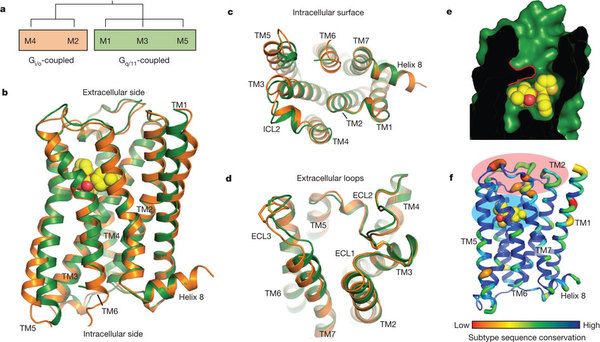
M1 Receptor
- These receptors are located mainly in the central nervous system (CNS), including regions such as the cortex, hippocampus, and striatum, as well as ganglionic cells.
- They are also located in peripheral neurons and in the parietal cells of the stomach.
- The receptor is also called the Gq muscarinic receptor as it is a Gq protein-coupled receptor.
Functions of the M1 receptor
- These receptors have excitatory effects on the CNS and are primarily involved with the control of motor functions, learning, and memory.
- In the stomach, they regulate gastric secretion via the vagus nerve.
- These receptors mediate the release of histamine, which stimulates histamine (H2) receptors in the stomach to secrete hydrochloric acid.
M1 agonist and antagonist
- Oxytremorine acts as an agonist for the M1 receptor, while pirenzepine and telenzepine act as antagonists.
M2 Receptors
- M2 receptors are mainly present in the heart and a few visceral smooth muscles.
- They are also found in presynaptic terminals of central and peripheral neurons.
The function of M2 receptors
- They have an inhibitory effect on the heart.
- In the heart, stimulation of M2 receptors leads to a decrease in heart rate (bradycardia) and a reduction in heart contractility.
- This occurs due to calcium channel inhibition.
- They also have an inhibitory effect on presynaptic neurons in the central and peripheral nervous systems.
- Their actions are also responsible for analgesia and tremor in Parkinsonism.
M2 receptor agonist and antagonist
- These are selectively stimulated by pilocarpine and antagonized by gallamine and methoctramine.
M3 Receptors
- These receptors are primarily found in smooth muscles of the eye, blood vessels, intestines, and glands.
- The glands include salivary glands, sweat glands, and those in the respiratory tract.
Function
- They control the constriction of the iris in the eye.
- In the lungs, they are involved in bronchoconstriction and facilitate expiration.
- They also dilate blood vessels by releasing nitric oxide, an endothelial relaxation factor.
- On the glands, they enhance secretion from the respective glands.
M3 receptor agonist and antagonist
- These are selectively stimulated by bethanechol and antagonized by solifenacin and darifenacin.
M4 Receptors
- These are located only in the brain and are mainly distributed in the forebrain and striatum.
Function
- They are thought to play a vital role in learning and drug abuse.
M4 receptor agonist and antagonist
- Oxotremorine, an agonist for all the above receptors, is also a non-selective agonist for the M4 receptor.
- However, the selective antagonist is Ipratropium and Mamba toxin (a snake venom)
M5 Receptors
- These are confined to brain regions such as the substantia nigra, striatum, hippocampus, midbrain, pons, medulla, cortex, and cerebellum of the CNS, as well as the iris of the eye.
Functions
- This receptor is thought to play an essential role in dopaminergic transmission in the brain. It also regulates salivary gland secretion and pupillary constriction.
Agonists and antagonists
- Acetylcholine and carbachol act as non-selective agonists. While atropine and oxybutynin act as non-selective antagonists.
- All the muscarinic receptors are G-protein-coupled receptors.
- But there are minor differences in the mechanisms of G-protein function across individual receptor types, as mentioned above.
Effects of Muscarinic Antagonists
Muscarinic antagonists (Anticholinergics) work by blocking parasympathetic effects, allowing the sympathetic system to dominate.
This leads to distinct changes across the major organ systems:
1. The Eye (M3 Dominance)
The eye iris has both circular and radial muscles that respond to sympathetic and parasympathetic stimuli.
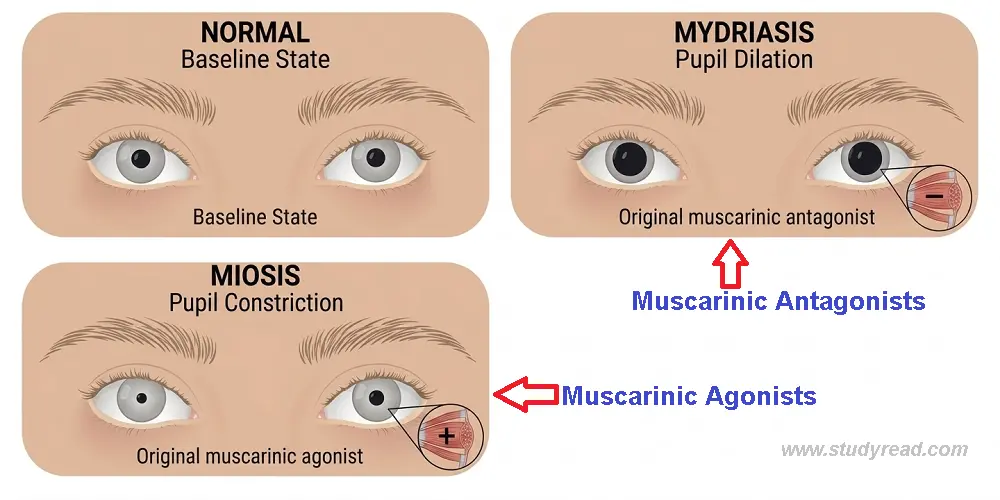
Parasympathetic stimulus causes the pupil of the eye to constrict, and hence muscarinic antagonists cause the pupil of the eye to dilate mimicing sympathetic effect.
- Agonist Effect: Stimulates M3 receptors on the iris sphincter muscle → Miosis (contraction). It also contracts the ciliary muscle, allowing for accommodation (near vision).
- Antagonist Effect (e.g., Atropine): Causes Mydriasis (dilation) and Cycloplegia (paralysis of accommodation).
- Clinical Note: This is why atropine substitute drops are used for eye exams, but are dangerous for patients with narrow-angle glaucoma.
2. Body Temperature & Sweat Glands (The Sympathetic Exception)
- The Mechanism: Most sweat glands are innervated by Sympathetic nerves, but they use Acetylcholine acting on M3 receptors.
- Antagonist Effect: Blockade of M3 receptors stops sweating (Anhidrosis).
- Result: This leads to “Atropine Fever” (hyperthermia), especially in children, because the body cannot cool itself by losin heat through sweat.
3. The Gastrointestinal (Gut) Tract
The gut uses a “synergy” of receptors of muscarinic class.
- M3 & M2: of them M3 initiates the contraction, while M2 helps in sustaining it.
- Agonists: Increase peristalsis and secretions (saliva, gastric acid).
- Antagonists: Decrease motility and secretions. This is why they are used as “Antispasmodics” for IBS, but their side effect is always constipation.
4. The Central Nervous System (CNS)
All five receptors are in the brain, but M1, M4, and M5 are the key players.
- Functions: Involved in memory, learning, and motor control.
- Antagonist Toxicity: Tertiary amines (like Scopolamine) cross the blood-brain barrier easily.
- At high doses, they cause the “Central Anticholinergic Syndrome”: confusion, hallucinations, and “mad as a hatter” behavior.
5. Cardiovascular System (The Heart)
The heart is primarily under the inhibitory control of the M2 receptors (via the Vagus nerve).
- Effect: Blockade of M2 receptors at the Sinoatrial (SA) node prevents acetylcholine from slowing the heart.
- Result: Tachycardia (Increased heart rate).
- Clinical Use: Atropine is the gold standard for treating symptomatic bradycardia and certain types of heart block.
6. Respiratory System (The Lungs)
In the airways, M3 receptors mediate smooth muscle contraction and mucus production.
- Effect: Antagonists block these M3 receptors, preventing the parasympathetic nervous system from constricting the bronchi.
- Result: Bronchodilation and a significant decrease in bronchial secretions.
- Clinical Use: Drugs like Ipratropium and Tiotropium are essential for patients with COPD and Asthma to keep the airways open.
7. Exocrine Glands (Secretions)
Muscarinic receptors (mostly M3) control almost all “wet” functions of the body.
- Effect: Blocking these receptors shuts down the secretory glands.
- Result: * Xerostomia (Dry mouth due to lack of saliva).
- Anhidrosis (Lack of sweating, which can lead to hyperthermia).
- Reduced Gastric Acid: M1/M3 blockade reduces stomach acid production.
- Clinical Mnemonic: “Dry as a bone” (no sweat/saliva) and “Red as a beet” (flushing due to inability to sweat).
