Enzymes are biomolecules that catalyze the conversion of a substrate into a product in living beings. These enzymes can be inhibited by 4 mechanisms, such as
- Reversible inhibition
- Competitive inhibition
- Noncompetitive inhibition
- Uncompetitive Inhibition
- Allosteric inhibition/ Feedback inhibition
- Irreversible inhibition
Core comparison of different types
| Inhibition Type | Binding site | Km Effect | Vmax Effect | Liveweaver-Burk Intersection |
|---|---|---|---|---|
| Competitive | Active Site | Increases (↑) | Unchanged (↔) | Y-axis (1/Vmax) |
| Non-Competitive | Allosteric Site | Unchanged (↔) | Decreases (↓) | X-axis (-1/Km) |
| Uncompetitive | ES Complex | Decreases (↓) | Decreases (↓) | Parallel lines (no intersection) |
| Mixed | Allosteric / ES Complex | Increases or Decreases | Decreases (↓) | Intersects left of the Y-axis |
Types of Enzyme Inhibition in Detail
Before going into detail, recall the enzyme action.
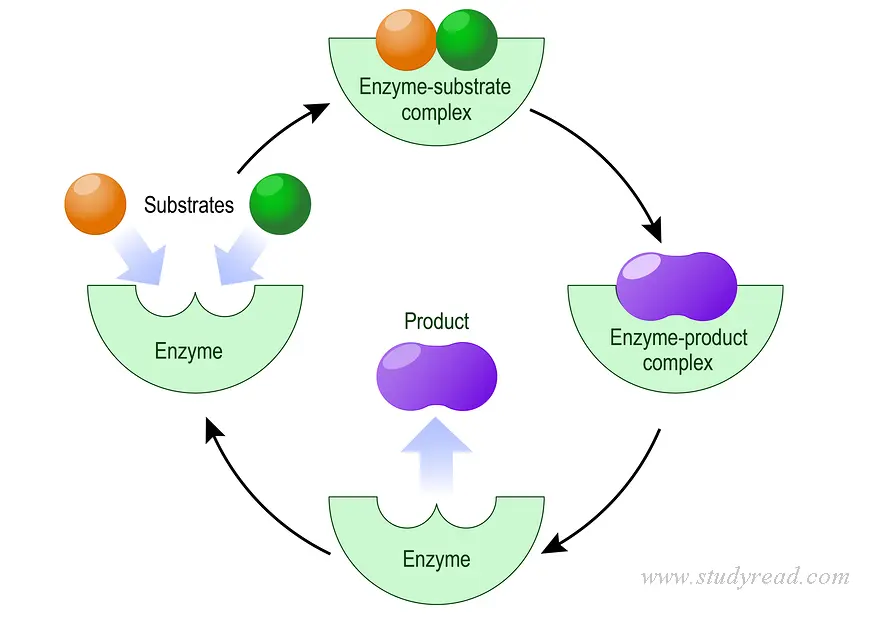
As seen above, the substrate binds to the enzyme at the active site and is converted into a product.
1. Reversible Inhibition
The inhibitor binds to the enzyme through loose, noncovalent, or transient interactions, such that it can be removed. As a result, the enzyme inhibition is reversed. This is also called equilibrium inhibition.
✅ This type of inhibition keeps the enzyme structure intact for future use.
It is of four types.
1. Competitive inhibition
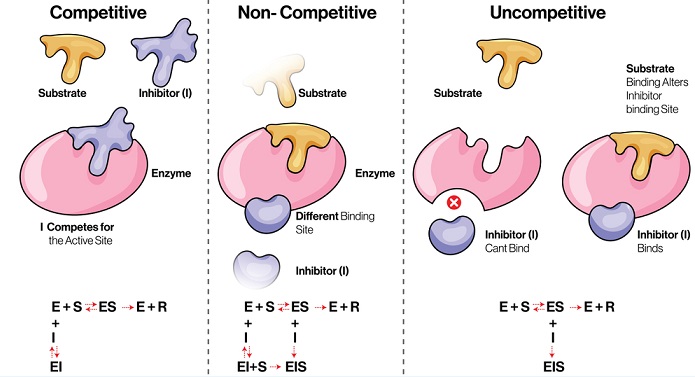
- Here, the inhibitor molecule is structurally similar to the substrate.
- So at the active site, the inhibitor competes with the substrate and binds there instead.
- Thus, the free enzyme is not available to bind the substrate until the competitive inhibitor leaves the active site.
The binding of a substrate to the active site produces a product.
Whereas binding of the inhibitor to the active site of the enzyme produces either no reaction or a non-functional product is formed.
- The relative concentrations of the substrate and the inhibitor, and their respective affinities for the enzyme, determine the degree of competitive inhibition.
- However, high substrate concentration displaces the inhibitor from the active site. Thus, the affinity has decreased (Km has increased), but the maximum velocity remains the same.
Therapeutic applications of competitive inhibition are
A. In methanol poisoning, ethanol is administered as an antidote.
- Methanol is metabolized to formaldehyde by the enzyme alcohol dehydrogenase (ADH). This formaldehyde further metabolizes into formic acid, which is toxic and causes adverse symptoms.
- Ethanol competes with methanol for the same enzyme, ADH, thereby preventing further formic acid formation and reducing toxic effects. (competitive inhibition)
B. Treatment of Gout
- Xanthine and hypoxanthine, byproducts of DNA metabolism, are converted to Uric acid by the enzyme xanthine oxidase.
- Excess uric acid deposits as crystals in the joints, causing gout.
- The drug allopurinol acts as a competitive inhibitor of the enzyme xanthine oxidase, thereby reducing the production of uric acid and helping in treatment.
C. Hypercholesterolemia treatment
- Enzyme HMG CoA reductase converts HMG CoA in the body to cholesterol.
- In cases of hypercholesterolemia, competitive inhibitors such as lovastatin are used to reduce cholesterol synthesis.
2. Noncompetitive inhibition
- In this reaction, the inhibitor binds to the enzyme at a point other than the active site. This impairs the enzyme function.
- Despite the inhibitor having no structural similarity to the substrate, it binds strongly at the enzyme’s second site, so it does not interfere with enzyme-substrate binding.
- Further, the inhibitor generally binds with the enzyme as well as the enzyme-substrate complex.
This way, it modifies the enzyme’s conformation, preventing catalysis.
- Thus, the substrate’s affinity for the enzyme is unaffected, but the maximum reaction velocity is reduced.
Examples: Heavy metal poisoning.
- Heavy metals such as Pb2+, Ag+, and Hg2+ bind to the cysteinyl sulfhydryl groups of enzymes, thereby noncompetitively inhibiting them and causing toxicity.
3. Uncompetitive Inhibition
- Unlike competitive and non-competitive inhibition, uncompetitive inhibition occurs when the inhibitor binds only to the enzyme-substrate (ES) complex and not to the free enzyme (E).
- This produces an inactive enzyme-substrate-inhibitor (ESI) complex, preventing the reaction from proceeding to yield products
Mechanism
- Substrate-Induced Binding Site: In uncompetitive inhibition, the free enzyme lacks a binding site for the inhibitor.
- Conformational Shift: When the substrate (S) binds to the active site of the enzyme (E), it induces a conformational change in the enzyme structure.
- Inhibitor Binding: This structural alteration creates a secondary binding site (an allosteric pocket) specifically tailored for the uncompetitive inhibitor (I).
- Trapping the Complex: Once bound, the inhibitor “traps” the substrate inside the active site, forming a dead-end ESI complex that cannot undergo catalysis to generate product (P).
Examples:
Memantine to manage Alzheimer’s disease.
- Memantine acts as an uncompetitive, open-channel blocker of the N-methyl-D-aspartate (NMDA) receptor.
- It requires the native substrate (glutamate) to first bind and open the ion channel before Memantine can enter and block excessive calcium influx, preventing glutamate excitotoxicity without interfering with normal physiological signaling.
Lithium in Bipolar Disorder
- Lithium ions act as uncompetitive inhibitors of the enzyme inositol monophosphatase (IMPase).
- Because it binds specifically to the enzyme-substrate complex, its inhibitory efficacy increases when cellular levels of the substrate (inositol monophosphate) are high, selectively dampening overactive phosphatidylinositol signaling pathways in hyperactive neurons.
4. Allosteric Inhibition
- Some enzymes possess additional sites, known as allosteric sites, in addition to their active sites.
- Such enzymes are known as allosteric enzymes, and their sites are specific to each enzyme.
- When the effector molecule binds to the allosteric site, the enzyme undergoes a conformational change that discourages substrate binding.
- Allosteric enzymes exist in two conformational states: the T (tense or taut) and the R (relaxed).
- The T and R states are in equilibrium with each other. Allosteric inhibitors favor the Taut state (T) while activators and substrates favor the Relaxed state (R).
Some enzymes inhibited by allosteric mechanisms are
- The enzyme hexokinase is inhibited by glucose-6-phosphate.
- The enzymes phosphofructokinase and isocitrate dehydrogenase are inhibited by ATP.
- Enzyme Acetyl CoA carboxylase is inhibited by palmitate.
Feedback inhibition

- Here, the end-product feedback regulates its own formation.
- This is a mechanism of enzyme inhibition in which the product of the biochemical reaction inhibits further enzyme activity.
- This occurs when the concentration of the product reaches certain levels. The product binds to the enzyme, induces conformational changes in it, and inhibits its catalytic function.
2. Irreversible Inhibition
- Here, the inhibitors form strong covalent bonds with the enzymes, irreversibly inactivating them. This is also called non-equilibrium inhibition.
- Usually, such inhibitors are known as poisons or toxins because their activity is difficult to control and they produce intense effects.
Some therapeutic examples of irreversible inhibition are
- Di-isopropyl fluorophosphate (DFP) is a nerve gas that irreversibly binds with enzymes containing serine at the active site (serine proteases, acetylcholine esterase). It was developed by the Germans during the Second World War.
- Organophosphates are irreversible inhibitors of acetylcholine esterase. This enzyme is essential for nerve signal transmission. So organophosphate poisoning results in muscle paralysis and eventually death.
- Iodoacetate is an irreversible inhibitor of enzymes like papain and glyceraldehyde 3-phosphate dehydrogenase.
- Penicillin is an irreversible inhibitor of serine-containing enzymes and blocks bacterial cell wall synthesis. Thus, it is a potent antibiotic.
- Disulfiram is a drug that irreversibly inhibits the enzyme aldehyde dehydrogenase, which leads to acetaldehyde accumulation in the body. This makes the person sick and makes him avoid further intake of alcohol.
Suicide inhibition
This is a special form of irreversible inhibition.
- Here, the original inhibitor loses its structure as it is acted upon by the same enzyme that it inhibits.
- It gets converted to a more potent form.
- The newly formed inhibitor binds irreversibly with the enzyme, whereas the original inhibitor would have bound reversibly.
- Thus, enzyme inhibition becomes stronger, and the maximum velocity cannot be reached.
Allopurinol is an example of suicide inhibition (used in the treatment of gout).
Allopurinol is an inhibitor of xanthine oxidase and binds to it.
- Xanthine oxidase converts Allopurinol to alloxanthine, a more effective inhibitor of the enzyme.
- Certain purine and pyrimidine analogs used in cancer therapy operate on the principle of suicide inhibition.
- The drug S-fluorouracil gets converted to fluoro-deoxyuridylate, which inhibits the enzyme thymidylate synthase. This inhibition reduces nucleotide synthesis.
- Because insufficient DNA and RNA are synthesized, the cancer cells cannot proliferate.

i love this