Dopamine is an important neurotransmitter that regulates movement, cognition, motivation, reward, and endocrine function.
This dopamine acts through different dopaminergic Receptors to produce its effects.
| Receptor Type | Specific Function | Specific Disease | Specific Drug Example |
| D1 | Motor control & cognition | Parkinson’s Disease | Fenoldopam (Agonist) |
| D2 | Locomotion & prolactin regulation | Schizophrenia & Hyperprolactinemia | Haloperidol (Antagonist) Cabergoline (Agonist) |
| D3 | Reward, motivation & impulse control | Drug Addiction & Impulse Control Disorders | Pramipexole (Agonist) |
| D4 | Attention & executive function | ADHD (D4.7 variant) | Clozapine (Antagonist) |
| D5 | Memory consolidation & synaptic plasticity | Cognitive Deficits & Dementia | Levodopa (Precursor) |
Alterations in dopaminergic signaling can lead to major disorders like Parkinsonism, schizophrenia, and hyperprolactinemia.
Therefore, mastering dopamine receptor pharmacology is essential for understanding drug mechanisms of action, managing therapeutic indices, and anticipating adverse drug reactions.
1. Neurobiology of Dopamine
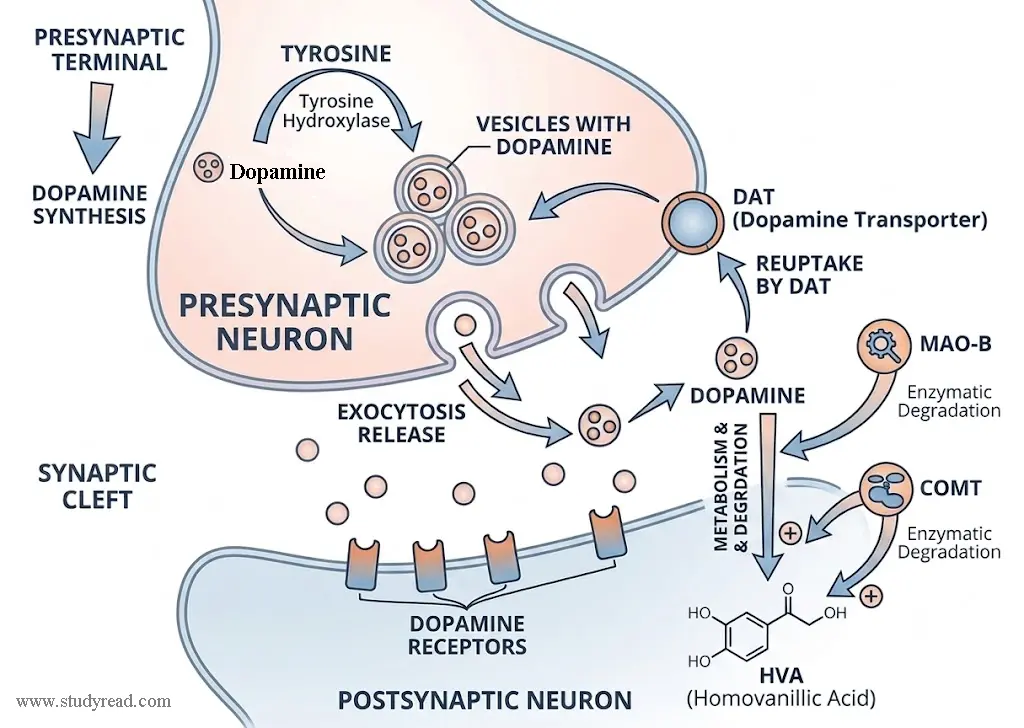
- Dopamine is synthesized in the presynaptic nerve terminals from the amino acid Tyrosine.
- It is released at synapses for signaling via exocytosis, and its effects are terminated by reuptake into the nerve terminal by the Dopamine Transporter (DAT), with partial termination by enzymatic degradation.
- The enzymes Monoamine Oxidase-B (MAO-B) and Catechol-O-Methyltransferase (COMT) metabolize dopamine into Homovanillic Acid (HVA).
The Four Major Anatomical Pathways
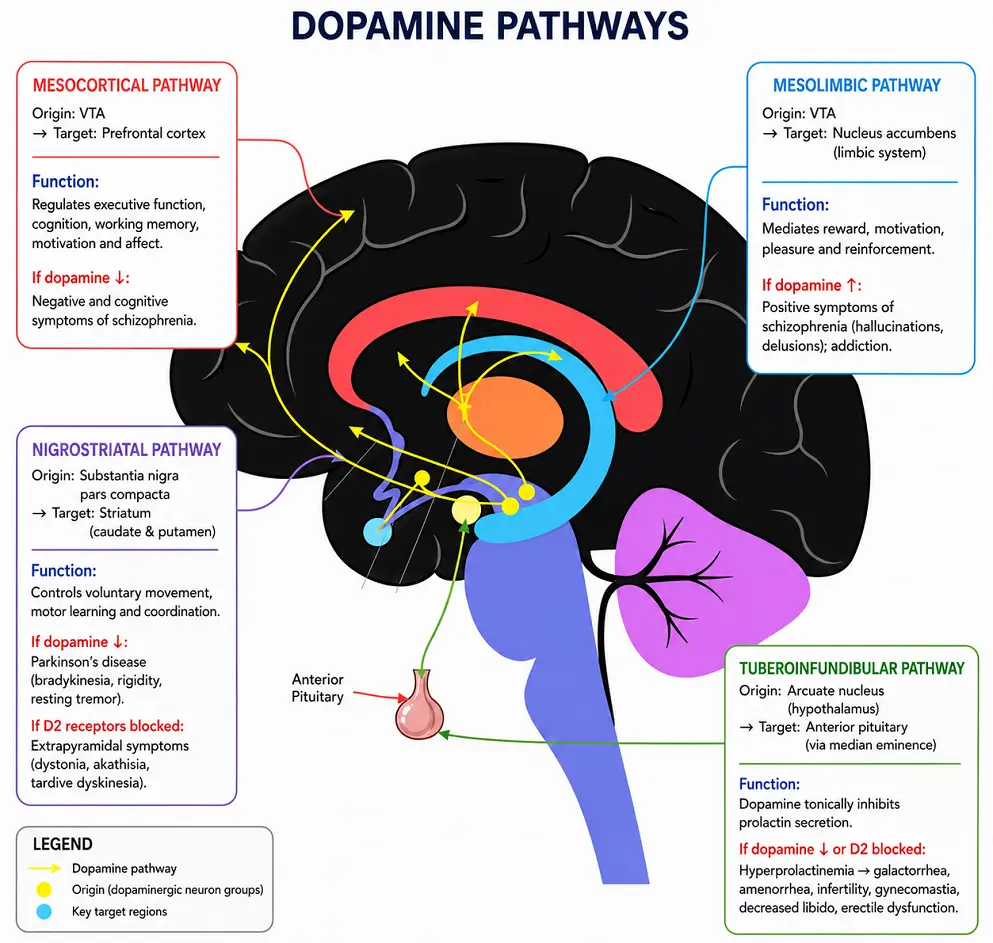
Dopamine receptor expression is distributed across four distinct functional pathways in the central nervous system:
- Nigrostriatal Pathway: It extends from the substantia nigra pars compacta to the striatum.
- It regulates voluntary motor control; its degeneration causes Parkinson’s disease.
- Mesolimbic Pathway: It is present from the ventral tegmental area (VTA) to the nucleus accumbens.
- It mediates reward, motivation, and reinforcement; hyperactivity drives the positive symptoms of schizophrenia.
- Mesocortical Pathway: Projects from the VTA to the prefrontal cortex.
- It governs executive function, cognition, and affect; hypoactivity drives the negative and cognitive symptoms of schizophrenia.
- Tuberoinfundibular Pathway: Projects from the arcuate nucleus of the hypothalamus to the anterior pituitary gland.
- Tonic dopamine release suppresses prolactin secretion.
2. Dopaminergic Receptors Classification & Structural Profiles
- There are a total of 5 types of dopamine receptors, like
- D1
- D2
- D3
- D4 and
- D5
However, based on their structure and intracellular coupling mechanisms, they are divided into two distinct subfamilies as
- D1 like family : D1 and D5 receptors
- D2 like family: D2, D3, D4 receptors
These dopamine receptors are classic 7-transmembrane G-protein coupled receptors (GPCRs).
3. Detailed Profiles of Receptor Subtypes (D1–D5)
| Receptor Type | Molecular Mechanism |
| D1 | Gs • Stimulates adenylyl cyclase • Increases cAMP |
| D2 | Gi/o • Inhibits adenylyl cyclase • Decreases cAMP |
| D3 | Gi/o • Inhibits adenylyl cyclase • Decreases cAMP |
| D4 | Gi/o • Inhibits adenylyl cyclase • Decreases cAMP |
| D5 | Gs • Stimulates adenylyl cyclase • Increases cAMP |
D1 Receptor
- Anatomical Distribution: Densely distributed in the neostriatum, cerebral cortex, nucleus accumbens, and olfactory bulb.
- Physiological role: It represents the most abundant dopamine receptor in the central nervous system.
- It directly collaborates with the D2 receptor in the striatum to modulate the “direct pathway” of movement control, enhancing voluntary locomotor activity and motor learning.
- Medicinal Chemistry for interaction: The presence of a catechol ring structure is essential for optimal agonist efficacy.
- Non-catechol drug molecules tend to act as antagonists or display low intrinsic activity.
D2 Receptor
- Anatomical Distribution: Mainly expressed in the striatum, substantia nigra, VTA, pituitary gland, and cortical areas.
- Alternative Splicing (D2S vs. D2L): The D2 gene’s alternative splicing yields two distinct isoforms:
- D2S (Short Isoform): Primarily localized presynaptically as an autoreceptor.
- It provides critical negative feedback to inhibit both the tyrosine hydroxylase activity and subsequent exocytotic dopamine release.
- D2L (Long Isoform): Primarily localized post-synaptically, serving as the principal target for traditional antipsychotic medications.
- Physiological role: Essential for the “indirect pathway” of the basal ganglia.
- It also provides essential tonic inhibition of lactotroph cells in the anterior pituitary, thereby suppressing prolactin release.
D3 Receptor
- Anatomical Distribution: Localized within the limbic system, the nucleus accumbens, islands of Calleja, and olfactory tubercle.
- Physiological Nuances: Exhibits an exceptionally high in vitro affinity for endogenous dopamine compared to the D2 subtype.
- Because of its selective localization within limbic reward centers, D3 signaling heavily drives reinforcement behavior, motivation, and drug addiction mechanisms.
- Clinical Link: Chronic, high-affinity stimulation of D3 receptors by exogenous dopamine agonists (e.g., pramipexole) is the primary trigger for Dopamine Dysregulation Syndrome (DDS), inducing impulsive behaviors like compulsive gambling and hypersexuality.
D4 Receptor
- Anatomical Distribution: Predominantly distributed in the prefrontal cortex, hippocampus, amygdala, and retina.
- Physiological role: Involved in complex executive functions, attention mechanisms, and working memory.
- The human D4 receptor gene exhibits pronounced genetic polymorphism. Its variant D4.7 is strongly correlated with a higher risk for Attention-Deficit/Hyperactivity Disorder (ADHD) and novelty-seeking behavior.
- Therapeutic Relevance: Atypical antipsychotics like Clozapine exhibit an extraordinarily high affinity for the D4 receptor, which contributes to its unique efficacy in the treatment of schizophrenia without causing severe extrapyramidal symptoms.
D5 Receptor
- Anatomical Distribution: Localized heavily within the hippocampus, lateral mammillary nuclei, and the thalamus.
- Physiological role: Displays a 10-fold higher binding affinity for endogenous dopamine than its D1 counterpart.
- Due to its concentration within the hippocampal formation, D5 receptor activation is a core driver of synaptic plasticity, long-term potentiation (LTP), and spatial memory consolidation.
4. Intracellular Molecular Mechanisms of Action
D1-Like Family Cascades (Gαs/Gαolf)
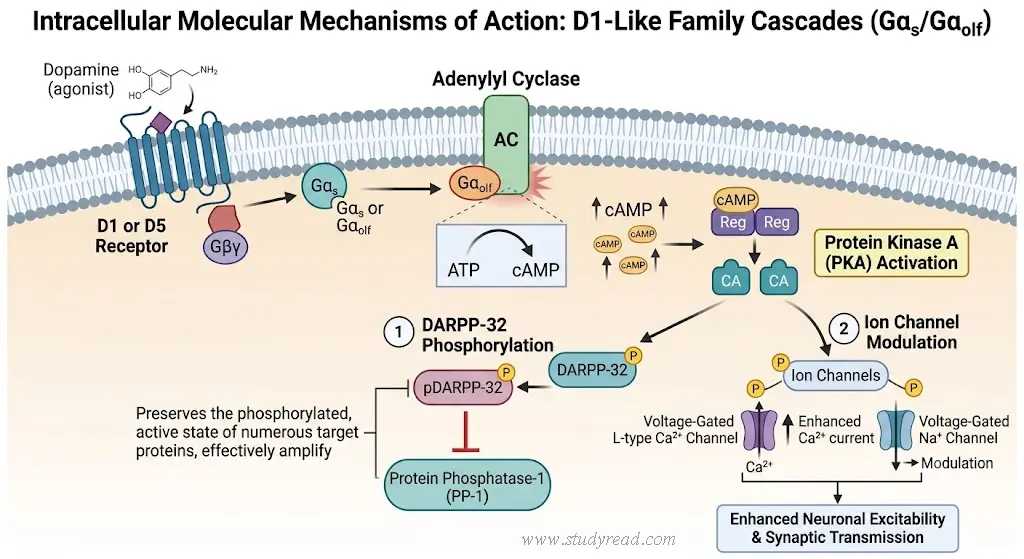
When an agonist binds a D1 or D5 receptor, it triggers the dissociation of the Gαs or Gαolf subunit:
- Adenylyl Cyclase Stimulation: The active Gα subunit directly activates the transmembrane enzyme adenylyl cyclase, catalyzing the conversion of ATP into cAMP (cyclic adenosine monophosphate (cAMP)).
- Protein Kinase A (PKA) Activation: Rising cytosolic cAMP levels bind to and activate PKA.
- DARPP-32 Phosphorylation: Active PKA phosphorylates DARPP-32 (Dopamine and cAMP-regulated phosphoprotein of 32 kDa), turning it into a potent inhibitor of Protein Phosphatase-1 (PP-1). This amplification step preserves the phosphorylated, active state of numerous downstream proteins.
- Ion Channel Modulation: PKA directly phosphorylates voltage-gated ion channels, enhancing L-type Ca2+ currents and modulating Na+ channels, thereby collectively boosting neuronal excitability and synaptic transmission.
D2-Like Family Cascades (Gαi/Gαo)
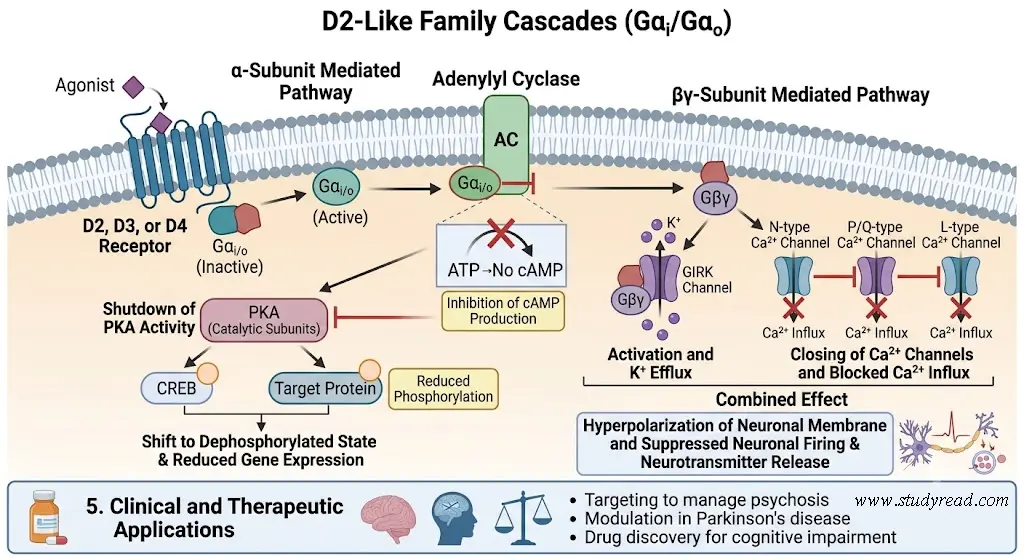
Activation of D2, D3, or D4 receptors induces coupling to the heterotrimeric Gαi or Gαo proteins, working via dual pathways:
The α-Subunit Mediated Pathway:
- The liberated Gαi/o subunit directly binds to and inhibits adenylyl cyclase, halting the production of cAMP.
- This shuts down PKA activity, shifting downstream target proteins into a dephosphorylated state and reducing overall gene expression mediated by CREB (cAMP response element-binding protein).
The βγ-Subunit Mediated Pathway:
- The dissociated βγ complex directly modulates ion channels independently of cAMP.
- It activates GIRK (G-protein-coupled inwardly rectifying potassium channels), prompting a massive efflux of K+ ions out of the neuron.
- Simultaneously, it closes N-, P/Q-, and L-type voltage-gated Ca2+ channels, blocking calcium influx.
- The combined effect of potassium efflux and halted calcium influx hyperpolarizes the neuronal membrane, heavily suppressing both neuronal firing rates and vesicular neurotransmitter release.
5. Clinical and Therapeutic Applications
| Drug Class | Prototype Examples | Primary Target Subtype | Clinical Applications | Crucial Adverse Effects |
| Dopamine Precursor | Levodopa / Carbidopa | Metabolic conversion to DA (binds all) | Parkinson’s Disease | Dyskinesia, motor fluctuations (‘on-off’), orthostatic hypotension |
| Non-Ergot Agonists | Pramipexole, Ropinirole | High D3 / D2 affinity | Parkinson’s Disease, Restless Legs Syndrome | Visual hallucinations, Dopamine Dysregulation Syndrome (DDS) |
| Ergot Derivatives | Cabergoline, Bromocriptine | High D2 agonist affinity | Hyperprolactinemia, Prolactinomas | Nausea, postural hypotension, cardiac valvular fibrosis (long-term) |
| Enzymatic Inhibitors | Selegiline, Entacapone | Preserves synaptic DA globally | Adjunct in Parkinson’s Disease | Insomnia, severe diarrhea (entacapone), hepatotoxicity (tolcapone) |
| Selective D1 Agonist | Fenoldopam | Peripheral D1 agonist | Hypertensive Emergencies | Reflex tachycardia, flushing, headache |
| First-Generation Antipsychotics | Haloperidol, Fluphenazine | Potent, non-selective D2 antagonist | Schizophrenia (Positive Symptoms) | Severe EPS, Tardive Dyskinesia, Hyperprolactinemia |
| Second-Generation Antipsychotics | Risperidone, Olanzapine | Modest D2 antagonist + 5-HT2A antagonist | Schizophrenia (Positive & Negative Symptoms) | Severe weight gain, metabolic syndrome, dyslipidemia |
| Dopamine System Stabilizers | Aripiprazole, Cariprazine | D2 partial agonist (D3 partial for Cariprazine) | Schizophrenia, Bipolar Disorder | Akathisia, mild nausea |
| Peripheral Prokinetics | Metoclopramide | Peripheral & Central D2 antagonist | Diabetic Gastroparesis, Antiemetic | Extrapyramidal symptoms, Tardive Dyskinesia |
6. Clinical Significance of Dopamine Receptors
- Dopamine receptors are important therapeutic targets in modern medicine.
- D1 receptor activation contributes to motor and cognitive functions.
- Whereas D2 receptor modulation underlies most antipsychotic and antiparkinsonian therapies.
- Alterations in receptor activity are closely associated with movement disorders, psychosis, endocrine dysfunction, and impulse-control disorders.
Dopaminergic Receptors & Medications
| Drug Class | Examples | Primary Target Subtype | Clinical Use | Major Adverse Effects |
|---|---|---|---|---|
| Dopamine precursor | Levodopa/ Carbidopa | Converts to DA, binds to all types | Parkinson’s disease | Dyskinesia, nausea, orthostatic hypotension |
| Dopamine agonists | Pramipexole, Ropinirole | High D3 / D2 affinity | Parkinson’s disease, Restless legs syndrome | Hallucinations, impulse-control disorders |
| Ergot derivatives | Cabergoline, Bromocriptine | High D2 agonist affinity | Hyperprolactinemia | Nausea, hypotension, cardiac valvular fibrosis (long-term) |
| MAO-B inhibitors | Selegiline, Rasagiline | Preserves synaptic DA | Parkinson’s disease | Insomnia, headache |
| COMT inhibitors | Entacapone, Tolcapone | Preserves synaptic DA | Adjunct in Parkinson’s disease | Diarrhea, hepatotoxicity |
| D1 agonist | Fenoldopam | Peripheral D1 agonist | Hypertensive emergencies | Reflex tachycardia |
| First-generation antipsychotics | Haloperidol | Potent, non-selective D2 antagonist | Schizophrenia | Extrapyramidal Symptoms (EPS) & Neuroleptic Malignant Syndrome (NMS) |
| Second-generation antipsychotics | Risperidone, Olanzapine | Modest D2 antagonist + 5-HT2A antagonist | Schizophrenia | Weight gain, metabolic syndrome |
| Partial agonists | Aripiprazole, Cariprazine | D2 partial agonist (D3 partial for Cariprazine) | Schizophrenia, Bipolar disorder | Akathisia, nausea |
| D2 antagonist | Metoclopramide | Peripheral & Central D2 antagonist | Gastroparesis, nausea | Tardive dyskinesia |
⮚ D Receptor Occupancy and Effects
The therapeutic effectiveness and side effects of medications depend on specific D receptor occupancy:
D2 receptor occupancy
For example, the effectiveness of antipsychotics depends on D2 receptor occupancy.
- <60%: Inadequate symptom control
- 60–80%: Optimal therapeutic range
- >80%: Increased risk of EPS and hyperprolactinemia
Tardive dyskinesia is a delayed movement disorder caused by prolonged D2 receptor blockage.
Chronic stimulation of D3 receptors
Dopamine agonists such as pramipexole, on chronic D3 receptor stimulation, may produce compulsive behaviors, including
- Pathological gambling
- Hypersexuality
- Compulsive shopping
- Binge eating
Conclusion
Dopamine receptors are part of a signaling system that regulates motor, cognitive, emotional, and endocrine functions.
Classification into D1-like and D2-like receptor families provides the foundation for understanding receptor physiology and pharmacology.
Understanding these pathways allows healthcare professionals to predict therapeutic effects, recognize adverse drug reactions, and provide safe, evidence-based patient care.
