Salivary glands are the exocrine glands that help to keep the mouth moist.
They are the accessory organs of the digestive system, and they help to
- Keep your mouth moist
- Sense the taste of food
- Chew the food well
- Clean the mouth of food debris.
- Prevent the growth of microbes in the mouth.
These functions are possible due to the saliva, a liquid secretion emerging from these glands in regular phases. Let’s see them in more detail below
Salivary Glands and their location
There are three pairs of salivary glands in the mouth, namely
a) Parotid glands (1 Pair)
b) Sub-mandibular glands (1 pair)
c) Sublingual glands (many small glands).
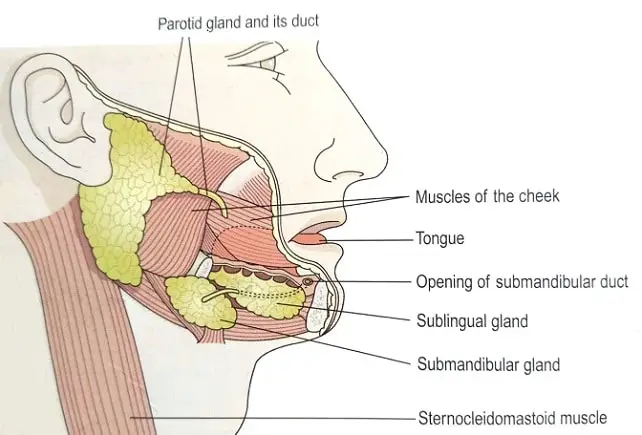
These salivary glands are exocrine in nature, meaning they secrete their content outside of their structure through a duct.
These ducts release saliva into the distinct regions of the mouth.
Parotid glands
- These are a pair of salivary glands located on either side of the face below the ears, as seen in the image above.
- Their salivary ducts open near the upper second molar teeth.
Sub-mandibular glands
- As the name indicates, these glands are located on the lower jaw angles on each side of the face.
- Ducts of these glands open on the floor of the mouth, with each on either side of the frenulum of the tongue.
Sublingual glands
- These glands lie on the floor of the mouth under the tongue and in front of the submandibular glands.
- They have many small ducts that open into the mouth floor.
- Thus, we can notice more saliva below the tongue.
- Besides them, there are numerous salivary glands scattered throughout the mouth at different locations.
Structure / Salivary Glands Anatomy
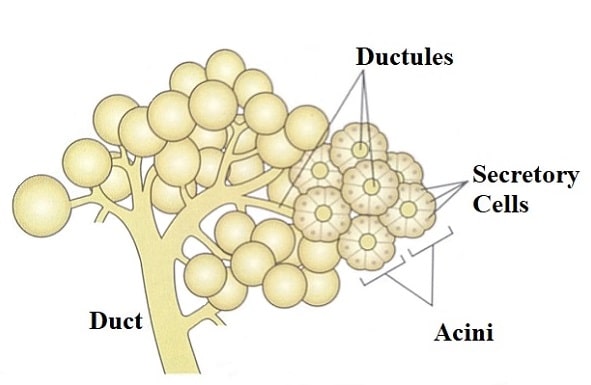
- Salivary glands are covered by a fibrous capsule.
- Each gland has a number of lobules within it. Each lobule is made of small acini.
- These acini are lined with secretory cells in a circular manner, as seen in the image above.
- Their secretions are collected into ductules. These ductules empty into the salivary ducts.
Blood supply to the Salivary glands
- Salivary glands secrete up to 1.5 liters of saliva per day.
- This can be possible if they have a good supply of water and other essentials.
- These glands are supplied with arteries from the branches of the carotid arteries in the neck region.
- They are drained by veins into the external jugular veins.
Nervous supply to salivary glands
- Salivary glands are supplied by the sympathetic and parasympathetic nerves.
- The glossopharyngeal nerve supplies the parotid gland.
- The parasympathetic stimulation causes profuse salivation, which is rich in water.
- In contrast, sympathetic stimulation inhibits salivary secretion.
- However, sympathetic stimulation over the sub-mandibular glands causes a small secretion, which is less watery.
- Besides, there is reflex stimulation, which can cause salivation when food is in the mouth.
- This gets conditioned fast, and whenever there is salivation at sight, smell, or even the thought of food.
- The profuse salivation during pesticide poisoning (organophosphorus poisoning) from the mouth is due to unhindered parasympathetic stimulation.
Facts
a) Your mouth is never dry because of the maintenance of the equilibrium of saliva secretion.
b) When eating something like a biscuit, and forgetting to drink water, still, after a few minutes, you will find that your mouth is clean. There would be no biscuit debris left in the mouth, as that would be carried away into the gut by saliva.
