There are five different types of immune cells in our body, like the
- Lymphocytes
- Monocytes and macrophages
- Basophils
- Neutrophils
- Eosinophils
Of these 5 cells, the lymphocytes, macrophages, and neutrophils play a major role in immunity.
- They destroy disease-causing agents, such as microorganisms, parasites, and toxins, to prevent infections.
- Some of these cells work by neutralization the foreign material.
- While others engulf and destroy the disease-causing microbes.
- However, few of them retain a memory of the previous attack, which prevents future chances of reinfection.
- This principle of immune memory is exploited in the preparation and use of vaccines.
Details on different types of immune cells
All the cells of the immune system are categorized as white blood cells.
However, they are again classified as granulocytes and agranulocytes.
The granulocytes include
- Acidophils (eosinophils)
- Basophils and
- Neutrophils
Of the three, the neutrophils have a prominent role in immunity.
The agranulocytes include
- Monocytes and
- Lymphocytes
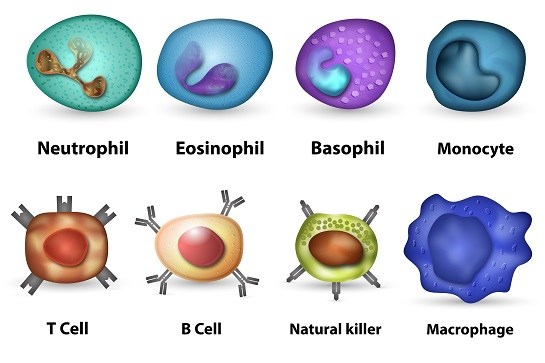
The shape of different immune cells in the body
The lymphocytes are the master cells of the immune system. They are differentiated into three sub-cells as
a) T lymphocytes
b) B lymphocytes and
c) Natural killer cells.
T lymphocytes
- These cells are processed in the thymus gland under the influence of the hormone thymosin.
- This leads to the formation of well-differentiated, mature, and functional T-lymphocytes.
- The T-lymphocytes are programmed to recognize only one specific antigen. Hence, they do not attack antigens or other foreign agents.
For example, T-lymphocytes directed against cancer cells only recognize and attack cancer cells. But they ignore other bacteria and virus particles.
- So, for every pathogen or foreign agent, a specific T-lymphocyte is generated.
- These T-lymphocytes provide cell-mediated immunity.
There are four different types of T-lymphocytes produced, like
- Memory T-cells
- Cytotoxic T-cells
- Helper T-cells
- Suppressor T-cells
Memory T-cells
- These are immune cells that live even after the infection is neutralized.
- This way, they are ready to produce a rapid immune response to any subsequent attack by the same pathogen or antigen.
Cytotoxic T-Cells
- These cells attack and inactivate the cells containing foreign antigens on their surface.
- Cytotoxic T-cells attach themselves to the target cells and release toxins like perforin.
- Since the cells are attached, the action is quite effective.
- The infected body cells and cancer cells are the main targets of these cytotoxic cells.
Helper T-cells
- These are the most common T-lymphocytes.
- They aid in both cell-mediated and humoral immunity.
a) For Cell-mediated immunity, they produce cytokines like interleukins and interferons, which stimulate cytotoxic T-cells and macrophages.
b) For humoral immunity, they stimulate B-lymphocytes to produce antibodies against the specific antigen.
- HIV attacks these cells, leading to a decrease in their numbers. This decrease compromises the body’s immune system.
Suppressor T-Cells
- These cells act as inhibitors, turning off the activated T and B lymphocytes.
- This way, they limit the extent of the damage to foreign bodies only.
- Thus, these inhibit any chances of potential damage to the body by the immune system.
B lymphocytes
- These cells play an essential role in antigen-mediated immunity (also called humoral immunity).
- They are produced and also activated in the bone marrow.
- They produce immune defenses by releasing antibodies, i.e., immunoglobulins.
These antibodies bind and destroy the antigen.
- These B cells constitute about 10-15% of the total lymphocyte count.
- They are less mobile than T-cells and release their antigens into the bloodstream.
- Hence, they remain in the lymph tissue for a considerable amount of time.
- Similar to T-lymphocytes, B-lymphocytes produce antibodies that are specific against one antigen.
- Upon contact with the antigen, the B-cells recognize and bind to it.
- Then, with the help of T-helper cells, B-lymphocytes enlarge and divide to produce plasma cells and memory B-cells.
Thus, there are two types of B-lymphocytes, like
- Plasma cells
- Memory B-cells
Plasma cells
- These cells produce large amounts of antibodies in the blood.
- These are carried to almost all tissues.
- They live for only one day at most and secrete millions of antibodies.
- All these antibodies are directed against one specific antigen.
These antibodies
- Bind to bacterial and other toxins, neutralizing them.
- They also bind to antigens of pathogens and help in recognition by the Cytotoxic T-cells and macrophages. This way, they help in the complete destruction of pathogenic cells.
- They also activate complement.
Memory-B cells
- These are similar to memory-T cells in function.
- They remain in the body for a long time after the initial attack is neutralized.
- When a subsequent attack occurs, they respond immediately by stimulating plasma cells.
- When stimulated, plasma cells release antibodies that target the antigen.
Natural killer cells
- These cells comprise approximately 10-15% of circulating lymphocytes and lack the markers of B or T cells.
- Natural killer cells are part of the natural or innate immunity.
- These cells recognize antibody-coated target cells and directly bring about the killing of the target.
This mechanism is mainly operative towards viruses and tumor cells.
Monocytes and macrophages
- The monocytes are the largest of the white blood cells.
- They remain in circulation for approximately three days before entering tissues, where they differentiate into macrophages.
The macrophage sub-population, like dendritic cells, is found in lymphoid tissue, as well as Langerhans cells.
The important immune functions of macrophages are as follows.
- Antigen recognition
- Phagocytosis
- Secretory function
- Antigen presentation.
Neutrophils
- These are granulocytic white blood cells. They are very high in number and constitute about 60% of all the W.B.C. combined.
- They are an important component of innate immunity.
- They are highly phagocytic in nature. They attack and engulf any microorganism present in the bloodstream.
- Once the microbe is engulfed, it is destroyed by the release of lysosomal enzymes.
- During an infection, they are the first to react and move toward the point of inflammation.
Eosinophils
- These cells are also called acidophils.
- They predominantly combat parasitic infections rather than microbial infections.
Basophils
- These cells are also involved in immune reactions.
- They can perform phagocytosis and release histamine and serotonin.
- They are found in large numbers at sites where there is an ectoparasitic infection due to ticks.
They are very few in number compared to other white blood cells.
Frequently asked questions and answers
How are immune cells able to detect foreign pathogens
The immune cells detect foreign cells due to the presence of antigens on the surface of foreign material.
They are trained to differentiate between endogenous and foreign substances.

really helpful, and wonderful note thank you.
Hi, I have mailed you a suitable remedy. Please try it out.
Is vasculitis caused by Eosinophils (i have twice as much as normal and half t cell count)
I have nearly died several times from several seasonal flues throughout my life.
I think I will not survive COVID.. now 64 yo
But Covid-19 hijacks all of them fighters as illustrated within the cartoon! Our bodies are at fault!