The GI tract is an essential part of the body that helps in food intake, digestion, nutrition supply, and removing waste from the body. Its organs include
- Tongue
- Salivary glands
- Teeth
- Pharynx
- Esophagus
- Stomach
- Small intestine (Deodenum, Jejenum, Ileum)
- Large intestine
- Rectum and
- anus
- Liver
- Pancreas

These organs help properly break down food, absorb essential nutrients, and eliminate waste.
Each has its own structure, composition, and function in the digestive system. Below, we will see them one by one in detail.
Organs of digestion in detail
Tongue
- It is the initial organ of digestion present in the oral cavity (mouth).
- The tongue is a thick, muscular organ that is reddish in color and highly flexible.
- The tongue is one of the sense organs in the body
This tongue helps in
- Taste perception
- Mixing of food with saliva
- Breakdown of food by chewing.
Salivary glands

- There are three types of salivary glands in the buccal cavity.
- These salivary glands secrete saliva into the mouth.
- This saliva contains
- Water
- Mucous
- Lysozyme enzyme (kills microbes)
- Salivary Amylase (digests carbs)
- The saliva helps
- To keep the mouth Moist
- Moisten the food for mastication
- Perceive the taste of food by chemoreceptors in the tongue.
- Partially digest carbohydrates by the enzyme amylase
- Clean the mouth free of food particles.
Teeth

- In an adult, there are 32 teeth, which are hardened structures.
- They help cut and grind the food into smaller particles for easy swallowing into the gut.
Pharynx
- It is a hollow tubular organ that connects the mouth with the esophagus.
- It helps to transport a bolus (food) from the mouth to the esophagus.
- It has taste buds that sense the taste of food.
Esophagus
- It is a muscular tubular organ that connects the pharynx to the stomach.
- It helps to transport food from the mouth to the stomach by small movements (peristalsis)

Stomach
- It is a sac-like structure located in the abdominal cavity below the thorax.
- It has four layers in its wall, and the innermost layer is the mucous layer.
- It secretes the gastric juice, which has
- Water (helps to moisten the food in the stomach)
- HCl (hydrochloric acid)- kills microbes and activates pepsinogens.
- Mineral salts
- Mucus
- Inactive enzyme pepsinogens
- An intrinsic factor that helps absorb Vitamin B12.
Functions of the stomach:
- Stores food temporarily for mixing with digestive juices.
- Mechanical breakdown due to muscular movements
- Absorption of water and alcohol.
- Non-specific defence against microbes.
- Helps in iron absorption.
Small Intestine
- The small intestine is a tubular organ that is present after the stomach and has a diameter of 1 inch.
- It has a length of almost 5 meters and extends up to the large intestine.
- The small intestine is arranged in folds in the abdominal cavity and can be divided into three parts, like
- Deodenum
- Jejenum
- Ileum
Deodenum
- It is the smallest of the three in length, ranging from 10 to 15 inches.
- The stomach opens directly into the duodenum and empties the gastric content in small portions.
- The hepatic and pancreatic ducts open into the duodenum through a common hepato-pancreatic ampulla.
- Through this, both the bile juice and pancreatic juice enter the duodenum and mix with the food (chyme) from the stomach to facilitate digestion.
- From here, the digestive contents enter the next part of the small intestine, the jejunum.
Jejenum
- This is quite lengthy and has a length of 8 feet.
- Here, the food is mixed with digestive juice to help in the breakdown of carbs, proteins, fats, and nucleic acids under the influence of pancreatic enzymes.
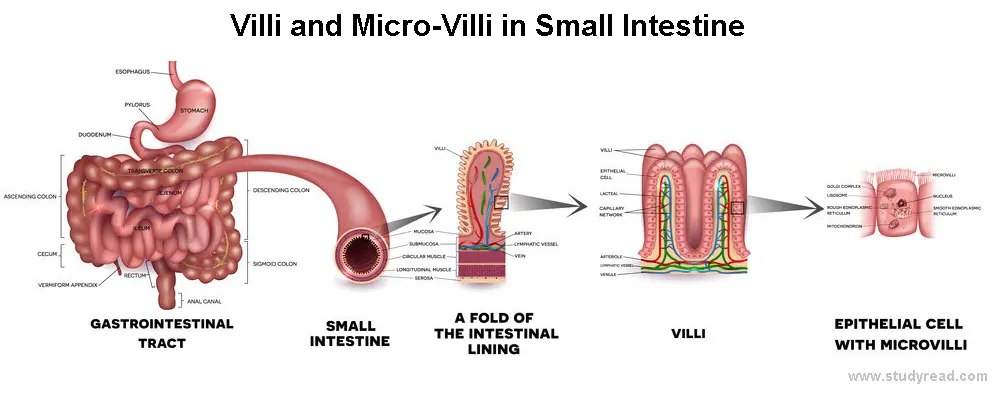
- The inner surface of the jejunum has Villi in its mucosal layer.
- Within these villi are microvilli, which help absorb nutrients from digested food.
- These villi have blood vessels and lacteals (lymphatic).
- Glucose and amino acids are absorbed by blood vessels, while lacteals take the fatty acids.
Ileum
- This is the last part of the small intestine, with a length of 6 to 10 feet.
- The digested food passes through this part of the small intestine and is digested and absorbed well.
- There are many lymphatic tissue patches called Peyer’s patches, which detect food composition.
- These can lead to an allergy to certain foods or pathogens.
- However, once habituated, they tend to accept the food, and their allergy can be gone.
Large Intestine
- The large intestine is broader than the small intestine and has a width of 2.5 inches and a length of 5 feet.
It has parts like
- The caecum
- The colon
- The caecum is the starting part of the large intestine. It has a vermiform appendix.
The Colon
It has three portions like
- Ascending colon
- Transverse colon
- Descending colon.
Ascending colon:
- It passes upwards from the caecum, curves, and becomes the transverse colon.
Transverse colon
- It extends across the abdominal cavity and bends to form the descending colon.
Descending colon.
- It passes downwards from the transverse colon and opens into the sigmoid colon.
The sigmoid colon.
- An ‘S-shaped’ structure passes downwards to form the rectum.
Rectum
- It is slightly dilated and 13 cms long.
- It connects the colon to the anal canal.
Anal Canal
- It is the final part of the abdominal canal.
- It helps in the passage of waste from the gut to the exterior of the body.
Function of the large intestine:
- It has microbes that break down biomolecules like bile pigments and produce vitamin K.
- Further, it helps absorb water and electrolytes into the body.
Accessory Digestive Organs
The liver and pancreas are the accessory digestive organs.
They are present near the gut and help with digestion and other functions.
Liver:
- It is the largest organ in the body, weighing between 2 and 5 pounds.
- The liver has four lobes and internally has hepatic cells, Kupffer cells, and sinusoids.
- It helps in metabolism, excretion, and even digestion.
Pancreas
- The pancreas is present below the stomach and above the duodenum.
- It has both endocrine and exocrine functions.
👉 The endocrine portion of pancreatic cells secretes hormones like insulin and glucagon, which regulate blood glucose levels.
👉 The exocrine portion secretes digestive enzymes, which digest the food material.
