Insects are the largest group on Earth, constituting about 80% of the animal population.
A typical insect has 6 legs and one or more pairs of wings.
Insects are of different types based on a few characteristics, and can be confused with worms.
Scientifically, one can easily classify them based on their morphology, habits, habitats, and other characteristics.
Types of insects
1. Based on food habits
a. Carnivorous insects:
- These insects rely on other animals’ tissue to feed on.
- They do not rely on a vegetarian diet.
- For this, they hunt and kill prey if needed.
Examples: Dragonflies, Tiger beetles
b. Herbivorous insects:
- They live exclusively on plant material like flower nectar, seeds, leaves, etc.
Examples: Honey bees, butterflies, dragonflies.
c. Omnivorous insects:
- These insects can eat both animal and plant diets.
Examples: Ants, house fly, female mosquito.
2. Classification based on the presence of wings:
a. Wingless insects:
- These insects lack wings in their entire life cycle.
Examples: lice, silverfish, firebrats.
b. Winged insects:
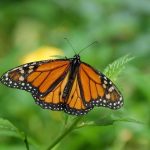
- These insects have wings. They are called true insects.
- In general, most insects have wings like
Examples: butterflies, house flies, honey bees, dragon flies, etc.
3. Types of insects based on the method of Living
a. Free-living type
- These insects live independently and search for their food.
- They mostly consume dead or plant material.
Examples: Cockroaches, honey bees, and dragonflies.
b. Parasites:
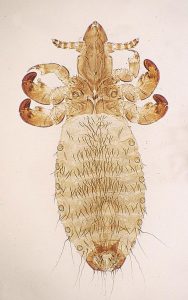
- These insects live as ectoparasites on other animals.
- They cannot survive without the presence of hosts.
Examples: Head louse, bed mites, etc.
4. Types based on the living environment or habitat:
- Insects differ in their place of abode, too.
- Few live on trees, while others live on land, and some of them live in water or on water.
- Based on this, we have
- Aquatic and
- Terrestrial insects.
a. Aquatic insects:
- These insects live in the water.
- They can even dive into the depths of the water and hunt the prey.
- They have special organs and methods of respiration as gills, respiratory tubes, etc.
Examples: Mayflies, diving beetles
b. Terrestrial insects:
- These are the insects that survive only on land.
- They may even make holes and deep dwellings inside the earth for survival.
Examples: Ants, cockroaches, etc.
5. Based on social behavior
- Insects, though being very tiny, have good communication among themselves.
- Most of the insects live alone, i.e., on their own.
- But some of them live in groups or colonies.
- So, based on this socializing behavior, we can classify them as
a. Individual/reclusive:
- These insects live individually and not in groups.
- They satisfy their own needs and do not support others.
Examples: Housefly, mosquito, etc.
b. Social insects:
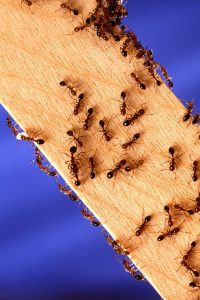
- These insects live in groups or colonies in a burrow or beehive.
- They share their food, shelter, and even work collectively to maintain their colony.
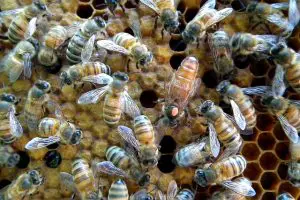
- They search for food and together work to collect and accumulate food.
- They even form specific directions or paths to collect food, as seen in ants and honey bees.
- They communicate with each other regarding the availability and direction of food.
- Typically, the group has a queen ant that lays eggs and male ants for fertilization and sterile female ants that act as workers.
- The female queen ant lays eggs. The worker ants or bees work to save, nourish, and protect the queen and offspring.
- Even there will be fights or wars between colonies, and large worker ants die to save their colony.
Conclusion
- They are robust in living and are widely distributed in the environment.
- Man has conquered every other animal except these insects.
- Some of the insects are useful to man, while a very few of them are harmful.
- But most of them contribute to nature and the ecosystem and help in pollination, acting as food to birds and other animals.
- Reptiles like snakes try to invade their ant-hill (formicary) for shelter.
- In such cases, ants attack them and may even kill them to save their nest.

Its better now or never .am impressed with your information regarding education and its fully packed