Enzymes are bio-catalysts or organic catalysts present in living cells.
They regulate various biochemical reactions without themselves being utilized in those reactions.
They enhance a reaction due to their presence in the body.
They are involved in many physiological processes, starting from digestion, excretion, and even reproduction.
Without enzymes, body physiology slows down and may lead to dysfunction.
There are many fatal disorders linked to enzyme deficiency.
Enzymes are present either in the whole body or confined few places in the body. They are present inside the cell and the cell organelles.
While some of them are secreted from exocrine glands for local action.
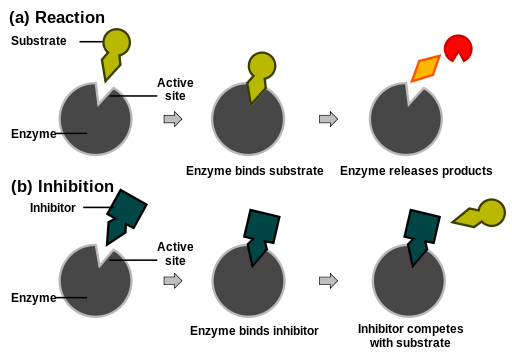
The enzymes can be differentiated into many types based on their physiological location, chemistry, and the mode of action.
Types of enzymes based on physiological location.
Systemic enzymes
- Systemic enzymes are those present in almost all regions of the body.
- Unlike the localized enzymes present in the digestive system or liver, these enzymes are present in every cell, tissue, and body region.
Systemic enzymes examples
- Proteolytic enzymes
- Plasmin
- Ceruloplasmin
- Alcohol dehydrogenase
- Cyclooxygenase (COX)
- ATPases
- Creatinine kinase
- Lactate dehydrogenase
Proteolytic enzymes
- Proteolytic enzymes are those that help in the breakdown of proteins.
- These enzymes, like hydrolase and renin, are found in the blood.
- Hydrolases are those that catalyze the breakdown of molecules by the addition of water molecules.
Renin
- It is an enzyme formed in the kidneys and released into the blood.
- This helps in the regulation of blood pressure by acting on the angiotensinogen protein.
Plasmin
- This is a protease enzyme that destroys clots in the blood.
- This keeps clots away and avoids the chances of stroke due to blood flow blockage.
- This enzyme is released as plasminogen from the liver into the blood, converting to an active form called plasmin.
Ceruloplasmin
- It is an enzyme in the plasma of blood that holds 95% of copper ions.
- If it does not hold copper ions, it can lead to an imbalance in homeostasis.
- Similarly, if this enzyme is overloaded with copper, it loses zinc and again leads to disorder.
Alcohol dehydrogenase
- This is an enzyme that converts alcohol into an aldehyde.
- It helps to break down alcohol, such as ethanol or methanol, in the body.
- This enzyme destroys the alcohol and helps expel it from the body.
Cyclooxygenase synthase
- Also called COX enzymes or Prostaglandin-endoperoxide synthase. These are of two types, COX-I and COX-II.
- COX-I is constitutive, while COX-II is an inducible enzyme.
👉 These enzymes synthesize prostaglandins from cell membranes by the use of arachidonic acid.
👉 They are also involved in the formation of different prostaglandins. Hence, anti-inflammatory drugs like aspirin inhibit COX-I and stop prostaglandin formation.
👉 This prevents further inflammation and pain. This enzyme inhibition sometimes has untoward side effects, such as gastric pain.
ATPases
- These are a set of enzymes like adenyl-pyrophosphatase, ATP monophosphatase, triphosphatase, etc.
- They help in the breakdown of the ATP into ADP and thereby release energy.
Creatinine kinase
- This is an enzyme found in muscles, the brain, the heart, blood, and other tissues.
- In muscles, it helps in the storage of energy as phosphocreatine.
Lactate dehydrogenase
- This is found in almost all the cells of our body.
- It helps in the conversion of pyruvate to lactic acid to generate ATP.
- This is especially an anaerobic way of energy production for the cells.
- These are the set of enzymes present in the whole body.
Local enzymes
- These are the enzymes that produce their effect only in certain parts of the body.
- Like hormones, they are formed inside some specific glands and then secreted nearby for physiological action.
Ex: Pancreatic enzymes are formed in the pancreas and released into the duodenum.
- But unlike systemic enzymes, they can be substituted externally in case of deficiency.
Ex: Digestive enzymes.
- In case of deficiency, similar digestive enzymes obtained from other sources can be administered for therapeutic effect.
Ex: Papain is isolated from papaya fruit by the enzyme immobilization technique and used to enhance digestion.
Types of Enzymes based on chemistry

These are of two types as
- Simple enzymes
- Complex enzymes
Simple enzymes
- Are those that are made of only a protein part and nothing else.
- Ex: digestive enzymes like amylase, pepsin, etc.
Complex enzymes
- These have a protein part and also a non-protein part.
- The non-protein part plays a key role in the action of enzymes besides protein.
- The protein part is called the apo-enzyme, and the non-protein part is a prosthetic group.
- The prosthetic group can be an inorganic part, like Zn, Cu, etc., which is called a cofactor.
- The prosthetic group that contains an organic group (ex, vitamin B3, etc.) is called a coenzyme.
But the modern classification is based on the International Union of Biochemistry and Molecular Biology (IUBMB).
Types of enzymes based on their function:
Enzymes are briefly classified based on the reaction they are involved.
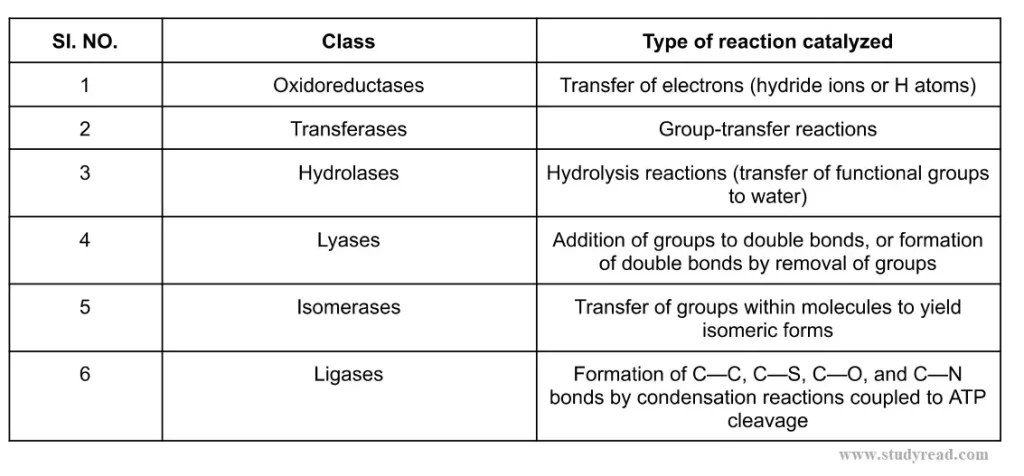
1) Oxidoreductases
- They catalyze oxidation-reduction reactions.
- There is either the addition of hydrogen (reduction), an electron, or the removal of oxygen (oxidation).
- Also, it can be an addition of an oxygen moiety (oxidation) or removal of an oxygen moiety (reduction).
Ex: alcohol dehydrogenase catalyzes the following reaction.
Acetaldehyde+ NADH2 —————->Ethyl alcohol + NAD.
2) Hydrolases
- They bring about the hydrolysis of substances by the addition of water.
- I.e., they bring about the breakdown by the addition of H and OH molecules to the substrate.
Ex: glucose-6-phosphatase
- Glucose-6-phosphate + H2O ———–> Glucose + phosphoric acid.
These are again of specific types like
| Hydrolaze type | Enzyme example | Substrate | Substrate example | Product formed |
|---|---|---|---|---|
| Carbohydrases | Sucrase | Carbohydrates | Sucrose | Glucose + fructose |
| Esterases | Lipase | Oils/Lipids | oil | glycerol+ fatty acids |
| Proteases | Trypsin | Proteins | Protein | polypeptides+amino acids |
3) Ligases
- These enzymes catalyze the formation of bonds. They are also called synthetases.
Ex: Acetyl CoA (vit-B5)
ATP+ acetic acid+ CoA——————>AMP+P-Acetyl CoA
4) Lyases
- These enzymes bring about lysis (breakage) of double bonds.
- They remove groups from double bonds.
Pyruvic acid ——————–> Acetaldehyde + CO2.
5) Transferases
- These enzymes help in the transfer of groups.
Ex: Glucose+ ATP—glucokinase—–>Glucose-6-phosphate+ADP.
6) Isomerases
- Iso-“similar,” mer-“pieces.” As the name indicates, they catalyze isomerization.
Glucose-6-phosphate ————–>Fructose-6-phosphate. In the presence of phosphoglucoisomerases.
Also read: The difference between enzymes and hormones
FAQs
What type of macromolecule is an enzyme
Enzymes are proteins by nature and hence, they are protein-type macromolecules.
